
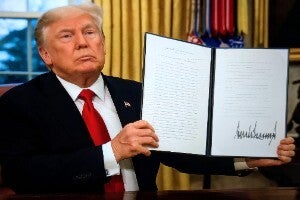
The recent issuing of Executive Order 14294 by President Trump, titled "Fighting Overcriminalization of Federal Regulations," marks a significant shift in how federal environmental crimes are enforced.
While the order aims to minimize burdensome and arbitrary prosecutions by emphasizing intent in criminal enforcement, it simultaneously raises the stakes for individuals and companies that knowingly or intentionally violate environmental laws.
Simply put, the order seeks to discourage the use of criminal enforcement for regulatory offenses, especially those with strict liability, where intent isn't a factor, and to prioritize civil or administrative remedies.
Signed on May 9, 2025, EO 14294 is part of a broader deregulation agenda intended to lighten the footprint of criminal enforcement in regulatory matters.
If you or your company is under scrutiny for alleged federal environmental crimes, it is crucial to understand the implications of this order.
Depending on the circumstances of your case, either the pressure on you could be greatly reduced, or you could run an even greater risk of criminal prosecution. Being well-informed and prepared is key in navigating the implications of this order.
Presidential Executive Order 14294
The Fighting Overcriminalization of Federal Regulations executive order says, "By the authority vested in me as President by the Constitution and the laws of the United States of America, it is hereby ordered:
Section 1. Purpose. The United States is drastically overregulated. The Code of Federal Regulations contains over 48,000 sections, stretching over 175,000 pages, far more than any citizen can read, let alone fully understand.

Worse, many carry potential criminal penalties for violations. The situation has become so dire that no one, likely including those charged with enforcing our criminal laws at the Department of Justice, knows how many separate criminal offenses are contained in the Code of Federal Regulations, with at least one source estimating that there are hundreds of thousands of such crimes.
Many of these regulatory crimes are "strict liability" offenses, meaning that citizens need not have a guilty mental state to be convicted of a crime.
This status quo is absurd and unjust. It allows the executive branch to write the law, in addition to executing it.
That situation can lend itself to abuse and weaponization by providing Government officials with tools to target unwitting individuals. It privileges large corporations, which can afford to hire expensive legal teams to navigate complex regulatory schemes and fence out new market entrants, over average Americans.
The purpose of this order is to ease the regulatory burden on everyday Americans and ensure no American is transformed into a criminal for violating a regulation they have no reason to know exists."
The following are the major provisions of this order that significantly impact how environmental crimes will be addressed. Let's delve into the key elements and provisions of this executive order. This will help us understand its implications for companies and their leaders.
Prioritization of Intent-Based Prosecutions
The EO narrows the scope of criminal enforcement to focus primarily on intentional or willful misconduct. Prosecutors are directed to pursue cases where the defendant's actions demonstrate a clear intent or constructive knowledge, such as falsifying reports or knowingly endangering public health and safety.
Meanwhile, strict-liability offenses, which do not require proof of intent, are now "generally disfavored" for criminal enforcement and will instead be subject to civil or administrative penalties.
While this shift reduces the overall number of potential criminal cases, it leaves less room for leniency in egregious or deliberate actions. This could potentially increase the workload of federal agencies as they focus more on investigating and prosecuting intentional violations.
Transparency Requirements for Agencies
To ensure consistent enforcement, federal agencies must publish annual lists of all enforceable violations, including corresponding penalties and mental-state requirements, such as intent, negligence, recklessness, and other relevant factors.
These requirements will provide businesses with clearer guidance on which actions constitute violations and their corresponding consequences. Criminal referrals for offenses not appearing on these published lists will be heavily discouraged.
Impact on Strict-Liability Environmental Offenses
Provisions within environmental laws, such as the Clean Water Act, the Comprehensive Environmental Response, Compensation, and Liability Act (CERCLA), and the Emergency Planning and Community Right-to-Know Act (EPCRA), often impose strict liability penalties for violations.
These include failing to report toxic releases, which may now be subject to civil or administrative penalties rather than criminal enforcement under the new EO.
The new EO casts doubt on the criminal enforcement of these offenses, signaling to agencies that they should avoid pursuing criminal charges in cases where no intentional misconduct can be proven.
Implications for Companies and Executives
EO 14294 is designed to alleviate the burden of environmental violations for many companies. However, it may pose a greater peril for a few whose violations are deemed intentional or egregious. Here's what you can expect as a result of this executive order:
- Fewer Prosecutions of Negligent or Unintentional Acts: This EO offers a sense of relief for companies and executives who unintentionally violate environmental laws. Criminal prosecution is less likely for negligence, although civil penalties may still apply; however, they are typically less severe. This shift in focus offers reassurance to companies striving to comply with environmental regulations.
- Higher Stakes for Intentional Violations: Although prosecutions for federal regulations may decrease under this order, the penalties for intentional violations are more severe. Crimes like falsifying environmental data, illegal dumping, or wildlife trafficking will still be strictly enforced. Resources previously allocated to minor violations can now be focused on prosecuting intentional acts with greater precision, underscoring the gravity of such actions and the need for strict compliance.
- Heightened Need for Compliance and Documentation: Businesses in regulated industries must adapt compliance programs to meet today's enforcement demands. Avoiding prosecution by eliminating negligence isn't enough; companies must demonstrate good-faith efforts to comply. Leaders should train employees on relevant laws, establish clear compliance protocols with regular audits, and monitor annual violation and penalty lists from regulatory agencies, underscoring the urgency and importance of these actions.
- Strategic Use of the Executive Order in Defense: For those accused of violations lacking intent, the EO may offer a defensive framework in negotiations or litigation. Defense counsel may use the EO's emphasis on intent to challenge charges based on negligence or strict liability, potentially resulting in reduced penalties or outright dismissal.
Why You Need an Experienced Federal Criminal Defense Attorney
The stakes in environmental crime cases are higher than ever. With the shift in prosecutorial focus to intentional misconduct, defending against charges requires a deep understanding of criminal intent and how federal agencies interpret and enforce these standards.
An experienced federal criminal defense attorney can provide invaluable assistance in assessing the government's case, identifying procedural missteps, and negotiating favorable settlements or advocating for case dismissal. A federal defense attorney with experience in environmental crimes can:
- Assess whether the government's case meets the EO's intent-based threshold for prosecution.
- Identify procedural missteps or overreach by agencies adhering to the EO's transparency and reporting requirements.
- Negotiate favorable civil settlements or advocate for case dismissal when intent cannot be proven.
For additional information, contact our federal criminal defense law firm, Eisner Gorin LLP, located in Los Angeles, California.
