
South Carolina Federal Criminal Defense Lawyers
If you're charged with a federal crime in South Carolina, your case will likely be heard at one of the district court locations of the U.S. District Court for the District of South Carolina.
Handling a federal criminal case is a whole different ball game compared to a state-level case. The procedures are stricter, the laws more complex, and the sentencing guidelines more severe. It's a daunting prospect that underscores the necessity of expert legal guidance.
Federal crimes are typically investigated by the FBI, DEA, IRS, or other federal agencies and prosecuted by attorneys in the U.S. Department of Justice.
The level of professionalism and the almost unlimited resources brought by federal prosecutors put a defendant in serious jeopardy of conviction and a lengthy sentence.
Our South Carolina criminal defense attorneys at Eisner Gorin LLP, with our extensive experience defending individuals and businesses against federal criminal charges, are here to provide you with the reassurance and guidance you need. Our expertise will give you the confidence to face your legal challenges.
Challenging the Prosecutor's Case
We understand the complexity of relevant laws and work tirelessly to challenge every element of the prosecution's case. Even when the facts seem to go against you, we can fight with determination to produce the best possible outcome, giving you hope for a favorable resolution.

A federal conviction can lead to long-term imprisonment, substantial fines, and other life-altering consequences. It's a grave situation that demands immediate attention and underscores the importance of seeking legal help.
That's why having a seasoned federal criminal defense attorney who not only understands but is well-versed in the intricacies of this court is key to building a solid defense.
If you're facing federal charges in South Carolina, rest assured, we have a deep understanding of the federal court system and can guide you through it with confidence.
Common Federal Criminal Cases in the District of South Carolina
At Eisner Gorin LLP, we defends physicians, nurses, accountants, business owners, politicians, attorneys, and anyone else seeking professional help against investigations involving the Drug Enforcement Agency (DEA), the Department of Justice (DOJ), the Department of Labor (DOL), the Federal Bureau of Investigation (FBI), the Department of State (DOS), and the Department of Homeland Security (DHS),
The U.S. District Courts for the District of South Carolina handle a wide range of federal offenses. Here are the most common types of cases that come through this court, providing a comprehensive understanding of the legal landscape:
- Drug Trafficking and Distribution Offenses: Including large-scale operations involving controlled substances such as cocaine, methamphetamine, federal drug conspiracy, and opioids.
- Federal Weapons Charges: Including possession of firearms by prohibited individuals, trafficking firearms, and firearms offenses linked to other crimes.
- White-Collar Crimes: Fraud, embezzlement, tax evasion, wire fraud, mail fraud, bank fraud, counterfeiting, mortgage fraud, and insider trading are among the most common federal charges in this category.
- Human Trafficking and Immigration Crimes: Offenses involving smuggling, harboring undocumented individuals, or violating immigration laws.
- Child Exploitation Crimes: Cases involving the production, possession, or distribution of child pornography.
- Healthcare Fraud: Particularly Medicare and Medicaid fraud.
- Federal Financial Crimes: Including bank fraud, credit card schemes, and money laundering.
- Computer Crimes: This includes hacking and unauthorized computer access under 18 U.S.C. 1030.
- RICO. This includes RICO allegations under 18 U.S.C. 1961 and obstruction of justice under 18 U.S.C. 1512.
Federal Subpoenas
Government subpoenas are an easy way to obtain information, and they do not even require the approval of a judge.

Whether your business received a subpoena from a Grand Jury in South Carolina, the Department of Justice, or the Department of Health and Human Services, Office of Inspector General, we can help you understand your rights and obligations under the law and guide you through the process of responding to the subpoena.
Regardless of whether the subpoena investigates a Controlled Substances Act case, a Healthcare fraud violation, or any other federal allegations, do not simply produce the requested records without consulting with a lawyer.
We need to discuss an approach to ensure you are not merely providing the government with information sufficient to prosecute you or expand its federal criminal investigation.
If you have any reason to suspect that you or your business may be the target of a federal subpoena or probe, call our law firm to review the details.
Overview of the District of South Carolina
The U.S. District Court for the District of South Carolina holds jurisdiction over federal cases occurring within the state--meaning violations of federal law, crimes occurring across state lines, crimes occurring on federal lands, etc.
By contrast, violations of state and local laws are handled in the state court system. As the name suggests, the District of South Carolina covers all 46 counties in the state.
Major cities served by the U.S. District Courts for the District of South Carolina include Charleston, Columbia, North Charleston, Mount Pleasant, Rock Hill, Greenville, and Spartanburg.
The courthouse location in Columbia serves as the primary headquarters, with additional locations in Anderson, Spartanburg, and Florence, as well as two locations each in Greenville and Charleston. The District of South Carolina is currently served by:
- Nine district judges
- Five senior district judges (tenured judges with lighter schedules to help with heavy caseloads); and
- Ten magistrate judges.
District judges serve lifetime appointments and oversee most of the criminal cases coming through the courts. Magistrate judges are appointed to 8-year terms and assist with preliminary hearings, as well as adjudicate most of the misdemeanor offenses.
Court Locations
Anderson
G. Ross Anderson Federal Building and U.S. Courthouse
315 South McDuffie Street, 2nd Floor
Anderson, SC 29624
Charleston
J. Waties Waring Judicial Center
83 Meeting Street
Charleston, South Carolina 29401
U. S. District Courthouse
85 Broad Street
Charleston, South Carolina 29401
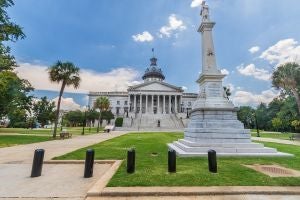
Columbia
Matthew J. Perry, Jr. U.S. Courthouse
901 Richland Street
Columbia, South Carolina 29201
Florence
J. L. McMillan Federal Building and U.S. Courthouse
401 West Evans Street
Florence, South Carolina 29501
Greenville
Carroll A. Campbell, Jr. U. S. Courthouse
250 East North Street
Greenville, South Carolina 29601
Clement F. Haynsworth Federal Building and U.S. Courthouse
300 East Washington Street
Greenville, South Carolina 29601
Spartanburg
Donald S. Russell Federal Building and U.S. Courthouse
201 Magnolia Street
Spartanburg, South Carolina 29306
How Federal District Courts Differ from State Courts
Our federal criminal defense lawyers in South Carolina specialize in defending individuals facing charges in federal court. Our attorneys possess in-depth knowledge of federal criminal law, procedures, and the specific rules of federal court, which differ from state courts.
If you've previously dealt with the state court system, you may find the federal judicial process more structured and rigid. Below are some critical differences to be aware of when your case is in the federal system:
- Federal Rules of Criminal Procedure: Cases in federal courts adhere to the Federal Rules of Criminal Procedure, a uniform set of guidelines that differ substantially from state rules. Procedural missteps can result in significant consequences for your defense.
- Pre-Trial Processes: Federal pre-trial processes, including discovery and pre-trial motions, are more meticulous and time-consuming.
- Sentencing Guidelines: Federal courts follow the U.S. Sentencing Guidelines, which offer little flexibility and often lead to harsher penalties than typical state court sentences.
- Higher Conviction Rates: Federal prosecutors are known for their high success rates due to extensive resources and the thorough investigations conducted by agencies such as the FBI, DEA, and ATF.
- Jurisdiction and Complexity: Cases in federal court often involve multi-state investigations, larger criminal enterprises, or violations tied to interstate commerce and federal agencies.
Why You Need a Federal Criminal Defense Attorney
Facing federal charges is an overwhelming experience, especially given the extraordinary stakes involved. Attempting to handle your case alone or hiring an attorney without extensive federal court experience can result in more severe outcomes.
For best results, you should hire a criminal defense attorney with specific experience in the U.S. District Court for the District of South Carolina. Here are just a few of the advantages of doing so:
- Familiarity with Federal Laws and Procedures: An experienced federal attorney knows how to interpret and apply complex federal statutes and procedural rules to build a strong defense.
- Knowledge of Local Judges and Prosecutors: Attorneys with a federal practice in South Carolina are familiar with the local judges' preferences, courtroom dynamics, and the tactics federal prosecutors use to win cases.
- Strategic Pre-Trial Preparation: A skilled attorney will conduct thorough pre-trial investigations, including analyzing evidence, locating expert witnesses, and crafting motions to dismiss or suppress evidence.
- Negotiation Experience: Given the high conviction rates, many federal cases are resolved through plea deals. A good federal defense attorney will know how to leverage skilled negotiation to get you the best possible terms if a plea agreement is in your best interests. If you're convicted, your attorney will also advocate effectively for the lowest sentencing possible under the federal guidelines, as well as leverage whatever mitigating factors are available.
- Access to Resources: Federal criminal cases often require expert witnesses, private investigators, and cutting-edge technology to challenge the prosecution's evidence effectively. A seasoned attorney ensures that these resources are at your disposal.
For additional information, contact our federal criminal defense law firm, Eisner Gorin LLP, located in Los Angeles, CA.
Related Content: