
Entry by False Pretenses into Federally Protected Property - 18 U.S. Code 1036
The federal government's unwavering commitment to the security of its properties, whether federal buildings or secure areas of airports, is a testament to its dedication to safety. Under Title 18 U.S. Code 1036, any attempt to breach these areas by 'fraud or false pretense' is not just a violation, but a federal crime.
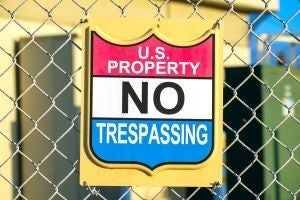
In essence, this federal law leaves no stone unturned in its mission to protect certain types of property, such as U.S. government land, vessels, aircraft, or secure areas at airports or seaports, from fraudulent entry.
The consequences are severe: a fine or up to 10 years in prison if the intent was to commit a felony, or a fine or up to 6 months in prison for other cases. A 'secure area' is a restricted zone defined by an airport authority, seaport captain, or public agency.
Simply put, this federal statute criminalizes entering any case of fraud or false pretense into land or buildings owned or leased by the United States, as well as boats, ships, or airplanes owned or leased by the United States.
It also includes unauthorized entry into restricted areas within an airport or seaport that are designated as secure in an approved security plan.
What Does Section 1036 Say?
Title 18 U.S. Code § 1036 - Entry by false pretenses to any real property, vessel, or aircraft of the United States or secure area of any airport or seaport, says -
(a) Whoever, by any fraud or false pretense, enters or attempts to enter-
(1) any real property belonging in whole or in part to, or leased by, the United States.
(2) any vessel or aircraft belonging in whole or in part to, or leased by, the United States.
(3) any secure or restricted area of any seaport, designated as secure in an approved security plan, as required under section 70103 of title 46, United States Code, and the rules and regulations promulgated under that section; or
(4) any secure area of any airport, shall be punished as provided in subsection (b) of this section.
(b) the punishment for an offense under subsection (a) of this section is-
(1) a fine under this title or imprisonment for not more than 10 years, or both, if the offense is committed with the intent to commit a felony; or
(2) a fine under this title or imprisonment for not more than 6 months, or both, in any other case.
(c) As used in this section-
(1) the term 'secure area' means an area access to which is restricted by the airport authority, captain of the seaport, or a public agency. This could include areas beyond TSA checkpoints in airports or restricted zones in seaports.
(2) the term "airport" has the meaning given to such term in section 47102 of title 49."
Title 18 U.S.C. 1036 - Explained
As noted above, 18 U.S.C. 1036 makes it a federal crime to gain access, or attempt to gain access, to specific government-controlled or secured areas through deception. The law is designed to protect sensitive locations from unauthorized individuals who might use fraud or deceit to bypass security.
The statute specifically prohibits using "any fraud or false pretense" to enter or attempt to enter the following types of property:
- "Real Property' of the United States: This includes any land or buildings that are owned, in whole or in part, or leased by the U.S. government. Examples could range from federal office buildings and courthouses to military bases and national parks.
- Vessels or Aircraft of the United States: Any ship, boat, or aircraft that is owned or leased by the U.S. government falls under this category. This could include Navy vessels, Coast Guard cutters, or government-chartered planes.
- Secure Areas of Airports and Seaports: The law covers designated secure or restricted zones within airports and seaports. These are areas where access is tightly controlled for security reasons (for example, tarmacs, baggage handling areas, and locations beyond TSA screening checkpoints).
Essentially, if you use a lie, a fake ID, a forged document, or any other form of deceit to get into one of these protected places, you could be charged under this statute. For instance, presenting a fake security badge to gain access to a restricted airport area would be considered 'fraud or false pretense' under this law.
Elements of the Crime
It's important to note that being in a restricted area alone isn't enough to secure a conviction under U.S.C. 1036. Prosecutors must prove specific elements beyond a reasonable doubt--specifically, that you:
- Used Fraud or False Pretenses: You used deception, such as making a false statement, presenting fake credentials, or misrepresenting your identity or purpose.
- Entered or Attempted to Enter: The law covers both successful entry and attempts. You can be charged even if stopped before gaining access.
- Targeted a Restricted Location: The property must be one listed in the statute, such as U.S. real property, a vessel, aircraft, or secure airport/seaport area.
- Acted Knowingly: You knew you were using false pretenses. Accidental misstatements or honest mistakes typically don't meet this standard.
Penalties for a Conviction
The penalties for violating U.S.C. 1036 are significant and vary based on the defendant's intent at the time of the offense. The law outlines two tiers of punishment:
- With Intent to Commit a Felony: If the government can prove that you entered the restricted area with the intention of committing another felony (such as espionage, sabotage, or a violent crime), the offense is punishable by a fine and imprisonment for up to 10 years.
- All Other Cases: If there was no intent to commit a separate felony, the offense is treated as a misdemeanor. The punishment is a fine and/or imprisonment for a term not exceeding 6 months.
What Are the Related Federal Statutes?
18 U.S. Code Chapter 47, fraud and false statements, contains numerous federal statutes that are related to 18 U.S.C. 1002, including the following:
- 18 U.S.C. 1001 - Statements or entries generally,
- 18 U.S.C. 1002 - Possession of false papers to defraud the United States,
- 18 U.S.C. 1003 - Demands against the United States,
- 18 U.S.C. 1004 - Certification of checks,
- 18 U.S.C. 1005 - Bank entries, reports, and transactions,
- 18 U.S.C. 1006 - Federal credit institution entries, reports, and transactions,
- 18 U.S.C. 1007 - Federal Deposit Insurance transactions,
- 18 U.S.C. 1010 - Department of Housing and Urban Development and Federal Housing Administration transactions,
- 18 U.S.C. 1011 - Federal land bank mortgage transactions,
- 18 U.S.C. 1012 - Department of Housing and Urban Development transactions,
- 18 U.S.C. 1013 - Farm loan bonds and credit bank debentures,
- 18 U.S.C. 1014 - Loan and credit applications generally; renewals and discounts; crop insurance,
- 18 U.S.C. 1015 - Naturalization, citizenship, or alien registry,
- 18 U.S.C. 1016 - Acknowledgment of appearance or oath,
- 18 U.S.C. 1017 - Government seals wrongfully used and instruments wrongfully sealed,
- 18 U.S.C. 1018 - Official certificates or writings,
- 18 U.S.C. 1019 - Certificates by consular officers,
- 18 U.S.C. 1020 - Highway project,
- 18 U.S.C. 1021 - Title records,
- 18 U.S.C. 1022 - Delivery of certificate, voucher, receipt for military or naval property,
- 18 U.S.C. 1023 - Insufficient delivery of money or property for military or naval service,
- 18 U.S.C. 1024 - Purchase or receipt of military, naval, or veteran's facilities property,
- 18 U.S.C. 1025 - False pretenses on high seas and other waters,
- 18 U.S.C. 1026 - Compromise, adjustment, or cancellation of farm indebtedness,
- 18 U.S.C. 1027 - False statements and concealment of facts in relation to documents required by the Employee Retirement Income Security Act of 1974,
- 18 U.S.C. 1028 - Fraud and related activity in connection with identification documents, authentication features, and information,
- 18 U.S.C. 1028A - Aggravated identity theft,
- 18 U.S.C. 1029 - Fraud and related activity in connection with access devices,
- 18 U.S.C. 1030 - Fraud and related activity in connection with computers,
- 18 U.S.C. 1031 - Major fraud against the United States,
- 18 U.S.C. 1032 - Concealment of assets from conservator, receiver, or liquidating agent,
- 18 U.S.C. 1033 - Crimes by or affecting persons engaged in the business of insurance whose activities affect interstate commerce,
- 18 U.S.C. 1034 - Civil penalties and injunctions for violations of section 1033,
- 18 U.S.C. 1035 - False statements relating to health care matters,
- 18 U.S.C. 1036 - Entry by false pretenses to any real property, vessel, or aircraft of the United States or secure area of any airport or seaport,
- 18 U.S.C. 1037 - Fraud and related activity in connection with electronic mail,
- 18 U.S.C. 1038 - False information and hoaxes,
- 18 U.S.C. 1039 - Fraud and related activity in connection with obtaining confidential phone records information of a covered entity,
- 18 U.S.C. 1040 - Fraud in connection with major disaster or emergency benefits.
Common Defenses Against False Pretense Charges
An accusation is not a conviction. A good federal criminal defense attorney can raise a number of defenses against charges under U.S.C. 1036, depending on the facts of your case. Common strategies include:
- Lack of Intent: A primary defense is arguing that you did not act with fraudulent intent. Perhaps you genuinely believed you were authorized to be there, or you made an honest mistake about your whereabouts.
- No False Pretense: You could argue that you did not use any form of deception. For example, if you simply walked through an open and unattended gate without making any statements or showing any documents, it may not qualify as a "false pretense."
- Not a Restricted Area: Your defense could focus on proving that the area you entered does not legally qualify as one of the locations protected under the statute.
- Mistake of Fact: This defense asserts that you were operating under a reasonable but mistaken belief. For example, you may have been given what you thought was a valid pass by another person, unaware that it was fraudulent.
For more information, contact our federal criminal defense law firm, Eisner Gorin LLP, located in Los Angeles, CA.
Related Content: