
Federal Drug Offense Defense Lawyers
Federal drug charges are among the most aggressively prosecuted crimes in the United States.
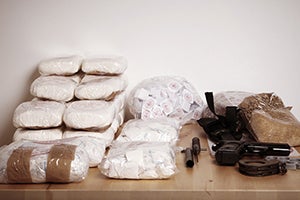
Unlike state cases, federal drug prosecutions involve mandatory minimum sentences, limited probation options, no parole, and powerful federal agencies such as the DEA, FBI, ATF, and U.S. Customs.
If you are under investigation or charged with a federal drug offense, your freedom, finances, and future are at immediate risk.
Understanding the different types of DEA search warrants—and how they are used—is critical to protecting your rights.
A DEA investigation is one of the most serious types of federal criminal investigations.
Federal court is an entirely different arena—and you need an experienced federal criminal defense lawyer who understands how to fight these cases from day one. Eisner Gorin LLP defends individuals nationwide against serious federal drug charges.
Your best hope for a favorable outcome is with a highly experienced criminal defense attorney. To schedule a consultation, call (818) 781-1570 or contact us here.
Federal Drug Laws Explained
Most federal drug offenses are prosecuted under Title 21 of the United States Code, including the Controlled Substances Act and the Controlled Substances Import and Export Act.
Federal drug cases are driven by:
-
Drug type and schedule
-
Quantity involved
-
Alleged role (user, courier, manufacturer, organizer)
-
Prior criminal history
-
Use of weapons or violence
-
Interstate or international activity
Congress's passage of the First Step Act significantly changed sentencing rules, but mandatory minimums still apply in many federal drug cases.
Pilots engaging in drug trafficking conspiracies face strict criminal penalties under 21 U.S.C. § 846, which provides that the punishment for conspiracy is the same as for the underlying offense.
Federal Drug Scheduling System
Federal law categorizes controlled substances into five schedules, based on abuse potential and medical use.
Schedule I
-
High potential for abuse
-
No accepted medical use
-
Examples: heroin, LSD, marijuana (federal law)
Schedule II
-
High abuse potential
-
Limited accepted medical use
-
Examples: cocaine, methamphetamine, morphine
Schedule III
-
Moderate abuse potential
-
Accepted medical use
-
Moderate or low physical dependence
Schedule IV
-
Low abuse potential
-
Accepted medical use
-
Examples: Xanax, Valium
Schedule V
-
Lowest abuse potential
-
Accepted medical use
-
Limited dependence risk
The schedule of the drug heavily impacts sentencing exposure.
Types of Federal Drug Crimes We Defend
Federal Drug Cultivation
Federal law criminalizes growing, possessing, or processing marijuana—even in states like California where marijuana may be legal under state law.
Federal cultivation charges may involve:
-
Possessing seeds
-
Planting or harvesting plants
-
Drying or processing marijuana
-
Possession with intent to distribute
Federal authorities routinely override state marijuana laws. Convictions can result in imprisonment, forfeiture, and substantialfines.
Federal Drug Importation
Drug importation involves bringing controlled substances into the United States from another country or across borders.
Commonly prosecuted drugs include:
-
Methamphetamine
-
Cocaine
-
Heroin
-
Marijuana
-
MDMA
Importation cases often involve:
-
Smuggling routes
-
Organized crime networks
These cases carry severe felony penalties and are prosecuted aggressively.
Federal Drug Manufacturing
Drug manufacturing charges apply to the production or preparation of controlled substances for sale.
This includes:
-
Operating meth labs
-
Drug processing operations
-
Possessing lab equipment or chemicals
-
Growing marijuana for distribution
Enhancements apply if:
-
Weapons were present
-
Manufacturing occurred near schools
-
Minors were involved
Manufacturing convictions often result in longer sentences than trafficking or possession alone.
Federal Drug Possession
While simple possession is often a state offense, possession becomes federal when it involves:
-
Large quantities
-
Intent to distribute
-
Interstate activity
-
Federal land or investigations
Convictions may trigger mandatory minimum prison sentences, especially with prior offenses.
Federal Drug Smuggling & Conspiracy
Smuggling cases frequently include drug conspiracy charges, which do not require proof that drugs were sold—or even possessed.
Prosecutors must only show:
-
An agreement to commit a drug crime
-
Knowledge of the conspiracy
This dramatically expands criminal exposure and sentencing risk.
Federal Drug Trafficking
Federal drug trafficking is one of the most serious offenses under Title 21.
Sentencing depends on:
-
Drug type and quantity
-
Involvement of minors
-
Prior convictions
Convictions can result in up to 40 years or more in federal prison, asset forfeiture, and deportation for non-citizens.
Federal Forfeiture and Asset Seizure
Federal drug cases often include civil and criminal forfeiture.
Authorities may seize:
-
Cash
-
Vehicles
-
Homes
-
Businesses
Forfeiture laws are governed by 18 U.S.C. Chapter 46 and are often tied to RICO investigations.
Defenses to Federal Drug Charges
Federal drug cases are defensible—but only with aggressive, early action.
Common defenses include:
-
Suppression of evidence
-
Unreliable confidential informants
-
Entrapment
-
Insufficient evidence
-
Chain-of-custody errors
-
Sentencing mitigation under the First Step Act
Federal prosecutors must prove every element beyond a reasonable doubt.
Why Federal Drug Defense Requires Experience
Federal court allows:
-
Fewer procedural mistakes
-
Harsher sentencing rules
-
Powerful investigative tools
-
Experienced prosecutors
You cannot afford inexperienced counsel.
Eisner Gorin LLP regularly appears in all U.S. District Courts in California, including the Central District of California, and defends clients nationwide.
Speak With a Federal Drug Defense Lawyer Today
Federal drug convictions permanently alter lives. Early intervention can:
-
Prevent charges
-
Reduce sentencing exposure
-
Avoid mandatory minimums
-
Protect property and freedom
If you are under investigation or have been charged with a federal drug offense, do not speak to law enforcement without counsel.
Pre-indictment advocacy is formal legal representation that begins during the federal investigation, before any indictment or criminal complaint is filed with the court.
📞 Call Eisner Gorin LLP at 877-781-1570 or contact us online for a confidential consultation. Our law firm is located in Los Angeles, CA
Related Content
- DEA Audit and Investigation
- Synthetic Cannabinoids
- Use of a Communication Facility
- Federal First Offenders Act (FFOA)
- What Is the Armed Career Criminal Act?
- What to Know About Federal Conspiracy Charges
- Pretrial Diversions in Federal Cases
- Causation Defenses in Fentanyl Cases
- How to Avoid Mandatory Minimum Sentences